

Conditions Change
And coalitions change with changing conditions


Thursday October 14, 1976 is the day I decided I wanted to be a journalist.
Barely eight weeks into my freshman year at SUNY-Binghamton, still one week shy of my eighteenth birthday, I convinced the news director of my college radio station to put me on a bus to Syracuse to cover a rally Jimmy Carter was holding as part of a swing through New York state.
It was exhilarating for someone just a few months removed from high school and not yet old enough to vote to stand in the press pool on that blustery fall day and watch the man who would be elected president three weeks later give his stump speech while staring down a heckler who shouted from the packed ballroom that Carter was going to start a nuclear war.
I went on to have a brief career in radio and television news, but it wasn’t long before I found a permanent home in academia. Still, when I look back on that day, two things stand out.
One is the adrenaline rush of covering a major news event.
The other is a sense of disbelief that just days before the election the Democratic presidential candidate was campaigning in . . . New York.
But New York was a swing state in 1976. In fact, half the country was up for grabs in that election, in which Carter started out way ahead, Gerald Ford closed the gap, and the final result was a nail biter that could have gone either way.
Here’s what the electoral map looked like in 1976:
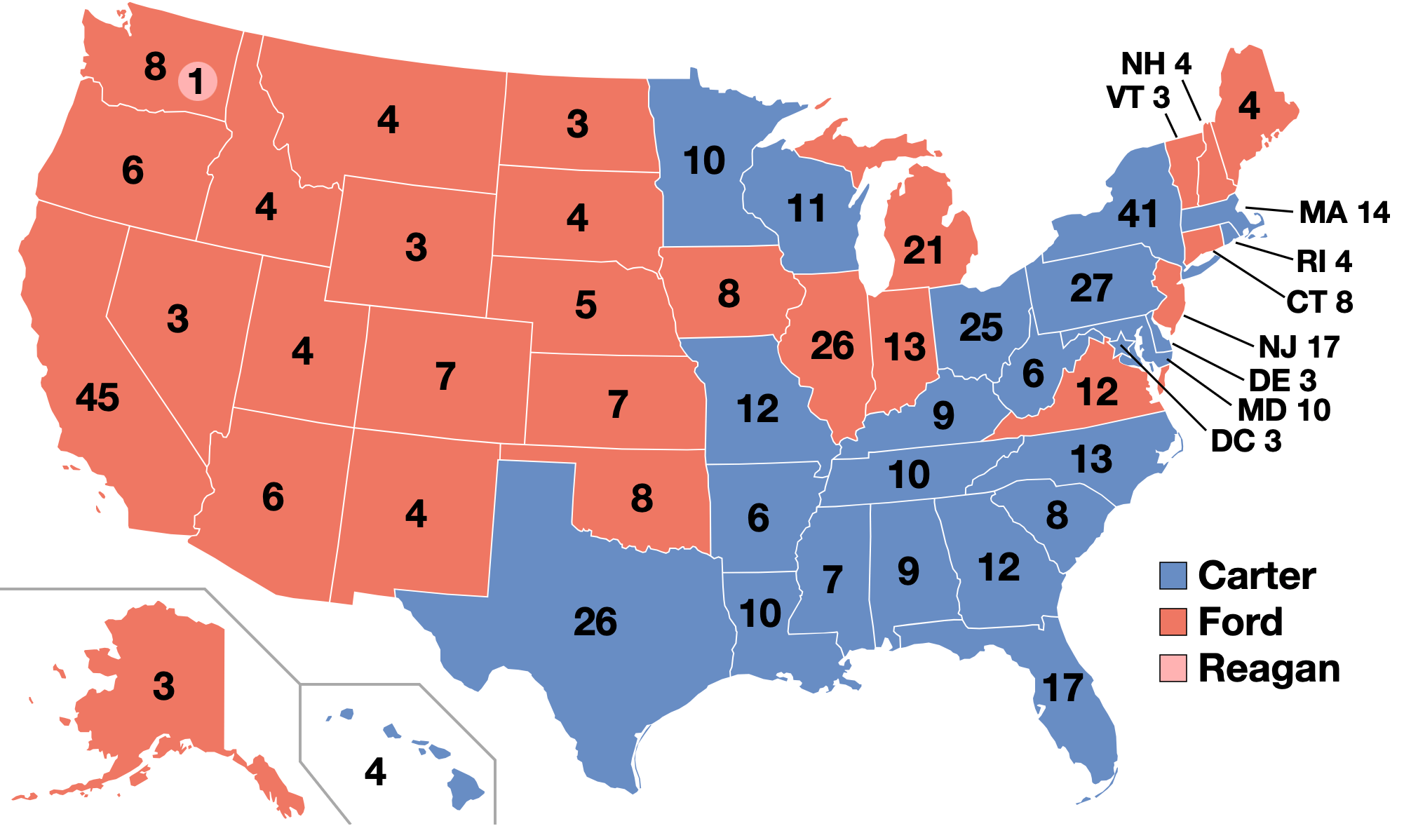
Source: SteveSims, Public Domain, via Wikimedia Commons
Whenever I show my undergraduate students this map they invariably have trouble wrapping their minds around it because it looks so different from anything they’ve seen in their political lives. The truth is, it looks different from anything we’ve seen this century.
We’re used to elections being confined to a handful of close states. The 1976 election was genuinely national.
Twenty states were decided by five points or less. Twenty-six states were decided by six points or less. Ford won Vermont, Connecticut, New Jersey, Illinois and California. Carter won West Virginia, Missouri, Texas and swept the Deep South. Apart from Hawaii, Carter didn’t win anything west of the Central time zone.
Carter won the popular vote by two points and the Electoral College 297-240. But it was so close that a shift of only 5,559 votes in Ohio and 3,687 votes in Hawaii from Carter to Ford would have delivered both states and the election to the Republican.1
Carter had managed—barely—to reassemble the core of the electoral map that powered Democrats from FDR through LBJ by bringing the South back into the Democratic fold.
There was no reason to believe at the time that it was the last gasp of a coalition in twilight.
Only in hindsight did the weakness of the coalition Carter assembled emerge from beneath his triumph. Carter narrowly won in 1976 despite running against an unelected president who could not escape the shadow of Watergate during a period of economic doldrums. When Carter was in office, the Democratic coalition proved unwieldy and often unmanageable.
Four years later, the bottom dropped out. The New Deal coalition was done. The map changed dramatically.
For the next dozen years, presidential elections looked nothing like they had in 1976. The nation was a field of red with scattered dots of blue. Republicans had assembled a new and dominant winning coalition that could not have been anticipated by the close Carter/Ford race.
By the turn of the century, the map changed again, morphing into the familiar cartography of a closely divided nation, where Democrats claimed the coasts, Republicans claimed the South and much of the Mountain West, and the Midwest was up for grabs.
This alignment will not endure forever.
The tendency to assume that what has been is always what will be feels natural enough, but history suggests otherwise. Coalitions change as conditions change, and they can change suddenly. A shock to the system can scramble the always-fluid boundaries of public opinion and unleash unexpected results.
Multiple deep shocks of the sort we are experiencing right now to our economic security, personal liberties, and foreign alliances can move public opinion in surprising ways, especially if those shocks endure for years. Elections that were fought on cultural grounds could suddenly be fought on economic grounds should enough voters experience and demand relief from economic hardship. Groups that long saw each other as adversaries could form new alliances if they share a common interest in reclaiming their safety and well-being from a commonly agreed-upon foe.
Donald Trump is doing more than his part to provide the energy that could forge a new political alignment. Nothing is guaranteed of course, including the possibility that Trump could regain the initiative in his march to autocracy. But if we have to withstand four years of the chaos we’ve endured for four months it could be more than enough to shuffle the deck of public opinion and generate outcomes we can’t fully anticipate at this point.
It was reasonable in 1976 to assume Carter had re-established the political order that had been briefly disrupted by Nixon’s narrow victory in 1968 and his landslide re-election in 1972. But Carter turned out to be the aberration while Nixon foreshadowed the new and lasting alignment that Reagan would bring into existence in 1980.
I was working on PBS election coverage that night in 1980 when Reagan was elected. Four years removed from my first encounter with journalism, I had dreams of being a writer or producer at CNN or ABC when the next presidential election rolled around. But on election night 1984, I was in an apartment in the Midwest working toward a degree that would allow me to pursue a calling I wasn’t even aware of at the time Reagan first claimed victory.
Conditions change. They can change suddenly. We may not know how and we can rarely predict when, but history tells us to be open to the possibility.
Or the Electoral College could have deadlocked. You may notice that Ronald Reagan received one electoral vote from Washington state—where Ford had won the popular vote. It was from a so-called “faithless elector” who supported Reagan, who had run against Ford in the primaries and almost won the nomination. With that vote and the electoral votes of Ohio and Hawaii, Ford wins the election 270-268; without it, the final tally is 269-268-1, and the election ends up in being decided by the House of Representatives. It’s unclear if that Washington State elector would have defected from Ford under these circumstances.
Getting through the next four years will test us. Institutions will crumble. This doesn’t have to be a bad thing. Time will tell. The parties will not save us.
Ah, political journalism. Even after reading The Boys on the Bus and understanding that it's not all investigative-journalism courage of Watergate and the Pentagon Papers, I never imagined I'd be so disappointed in so much of conventional journalism. We're fortunate to have access to other voices.