

Your Blue Wave Tracker: June Update


It’s been three months since I introduced the Blue Wave Tracker and two months since I last wrote about it. The tracker lists eight measures which together can tell us how likely it is that Democrats are heading for an overwhelming electoral performance in the fall.
As I wrote in March:
Waves happen when the electorate repudiates a party. In wave years, the opposition party performs at or even beyond the high end of what is believed possible, winning states and districts that would not be competitive in a normal year. Waves can generate stunning and unexpected upsets. They can see most close races fall in unison to the opposition. They can leave the incumbent party with little more than debris to gather from their former majority position.
In March, all signs suggested a massive wave was forming. Three months later, the electoral environment looks remarkably consistent.
Here is how things look in mid-June:
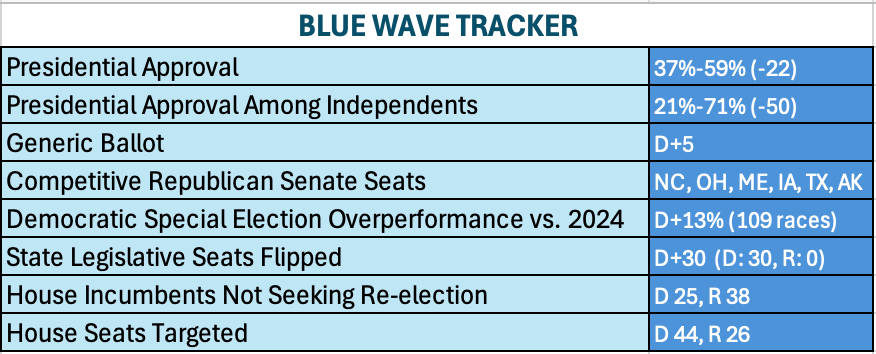
Off-year elections are driven by sentiment toward the incumbent administration, and Donald Trump is even more deeply disliked than he was last spring. Presidential job approval, which was 19 points underwater in mid-March and 20 points underwater in mid-April, is now 22 points underwater according to the site Fifty Plus One. Trump has lost the support of three-fifths of the country—a stunning figure—while only 37% of Americans think he is doing a good job. He is so deep in the danger zone that it is hard to see how Republicans recover, especially with the election now only four months away.
But the figure that jumps off the table is Trump’s job approval among independent voters. According to an Economist/YouGov poll conducted three weeks ago, Trump is underwater by 50 points among independents, with 71% disapproving of his performance. That’s worse than the 65% figure recorded in April and represents a complete collapse with a group that is vital to winning the midterms. As we noted in March and April, Republicans cannot lose independents by such a lopsided margin and remain competitive. And if the preferences of independents track this closely with Democrats while Republicans are less motivated than Democrats to turn out, you have the recipe for a tidal wave.
The rest of the metrics I’ve been following remain stable from two months ago. This includes the generic ballot—an aggregate measure of which party people would select with their congressional vote—which remains at D+5 according to Fifty Plus One.
It includes Democratic over-performance in special elections, which according to The Downballot remains at 13% across 109 special elections held in 2025 and 2026.
And Republicans have still not flipped any Democratic state legislative seats, while Democrats have flipped 30 Republican seats this cycle.
Meanwhile, more Republicans than Democrats will retire from Congress this year, giving Democrats more opportunities to pick up open seats. Accordingly, Democrats continue to outpace Republicans in the number of House seats they are targeting. These figures are unchanged from earlier in the year.
The one place where the political environment has improved for Democrats over the past two months is in the race for control of the Senate. Democrats need to net four seats to claim a Senate majority. In April, we identified six states where Democrats have a realistic chance of flipping Republican seats: North Carolina, Ohio, Maine, Iowa, Texas, and Alaska. All six remain competitive—or better—in June.
In North Carolina, Democrat Roy Cooper holds a nine-point lead in polling averages and is close to breaking the 50% mark.
In Ohio, a recent Fox News poll shows Democrat Sherrod Brown up 53%-45% over Jon Husted, the Republican appointed to fill the vacancy created when JD Vance became vice president.
In Alaska, Democrat Mary Peltola holds a consistent lead of at least five points over incumbent Republican Dan Sullivan.
In Maine, where Democrat Graham Platner has been under fire for revelations about his personal life, June polling shows a close contest with Susan Collins, with Platner in the lead by two or three points.
In Iowa, freshly-minted Democratic nominee Josh Turek is in a dead heat with Republican nominee Ashley Hinson.
A close race is developing in Texas, where polling averages show James Talarico running even with or slightly ahead of Ken Paxton.
And potentially competitive races in two other red states may be on the horizon.
Several recent polls suggest a tight contest is developing in Florida, where Democrat Alex Vindman is challenging Republican Ashley Moody, who was appointed to replace Marco Rubio when he joined the Trump administration.
There has been limited polling of the Nebraska Senate race, but a survey released last month showed independent candidate Dan Osborn, who has the support of Nebraska Democrats, running ahead of Republican incumbent Pete Ricketts.
What it means
The stability of the Blue Wave Tracker over the past three months points to a political environment where the fundamentals are largely fixed. Donald Trump is historically unpopular, and that is allowing Democrats to compete in red districts and states that would be out of their reach in a more balanced electoral climate.
The fact that Democrats have a realistic path to a Senate majority that runs through North Carolina, Ohio, Alaska, Iowa, and Texas tells us everything we need to know about how this cycle is shaping up. One year ago, it would have been reasonable to be skeptical that Democrats could compete in places that have been inhospitable to them for so long.
It is now officially summer, and Republicans are running out of time to turn things around. But they couldn’t save themselves if they had forever—because they are beholden to a president who is unable to acknowledge the disaster he has unleashed on the country and unwilling to change course.
Republicans have no accomplishments to take to the public. They own inflation. They own the Iran War. They own their votes on the reconciliation bill that shifted wealth upwards.
So they are going to attack Democrats. They have no other choice.
When you cannot run on your record and the country is poised to reject you, the only move you have is to make your opposition look worse than you do.
That means this midterm cycle will be ugly. Trump will keep trying to upend or delegitimize the election while Republicans on the front lines will lob everything they have at their opponents.
It has the feel of desperation.
Because it is.
Early last year, Republicans stopped holding town hall meetings with angry constituents who were shouting at them to stand up to Donald Trump.
They chose to run away rather than listen.
But they won’t be able to hide from what’s coming in November.
Like everyone else, I find the reflecting pool being well-greened by a firm called Greenwater to be very entertaining.
But, hoping the Epstein files and expensive gas continue to be news topics through November! The fact that the Administration continues to violate the law for 7 months and counting is deserving of more news coverage.
The Reflux-ing Cesspool is the best Trolling Material so far. And he can't help perpetuating it himself.
Thanks for the info 👍. Subscriber here.